COO

Moving IT support offshore or to a third party can shift who controls access decisions, making account and permission changes slower than before. This delay often goes unnoticed until a staff change or security incident demands immediate action. Businesses risk exposure when speed is most needed.
Picture this: a staffer walks out the door on a Friday afternoon, still holding credentials to the customer database, and the request to cut off that access now has to travel through a help desk overseas before anyone can act. That gap is where the real tradeoff in outsourcing lives.
Companies that hand IT support to an outside provider usually do it for the same reasons: lower costs, specialized skills on tap, and a team freed up to focus on the business itself. Those are the real benefits of IT outsourcing, and they explain why so many businesses make the switch. Yet underneath that upside sits a quieter shift—one that shows up specifically in how access gets granted, changed, and revoked.
Outsourcing IT support can mean longer waits for access changes, because decisions about who can access what are no longer made directly by your team.
That single change ripples outward. Once an external provider owns the process, even a simple request—adding a new hire, removing a departing one—has to pass through extra steps that didn't exist when the work stayed in-house.
For a business in Denton that depends on fast turnarounds during staff changes or security incidents, that extra layer of process matters more than it might elsewhere. Before signing an outsourcing agreement, it's worth understanding exactly how that shift happens.

Outsourcing IT services moves the job of managing user accounts and permissions outside the immediate team, and that relocation changes more than an org chart—it changes response time.
An internal IT staffer typically knows the company's people, its structure, and what matters right now, so changes happen fast because the context is already understood. A third-party provider has none of that built-in context, so it leans on formal requests and documented approvals instead. That process exists for good reason—it protects security—but it also adds time that didn't used to exist.
Consequently, when an employee leaves suddenly, or someone needs urgent access, the request now waits in the provider's queue rather than getting handled on the spot. That delay rarely shows up on paper until it's actually being lived through. Layered on top of it, the provider's own approval policies—about who's authorized to sign off on a change—can slow the process down even further.
Add it together, and the business ends up reacting more slowly than it once did, and in a fast-moving situation, even a short delay can matter.
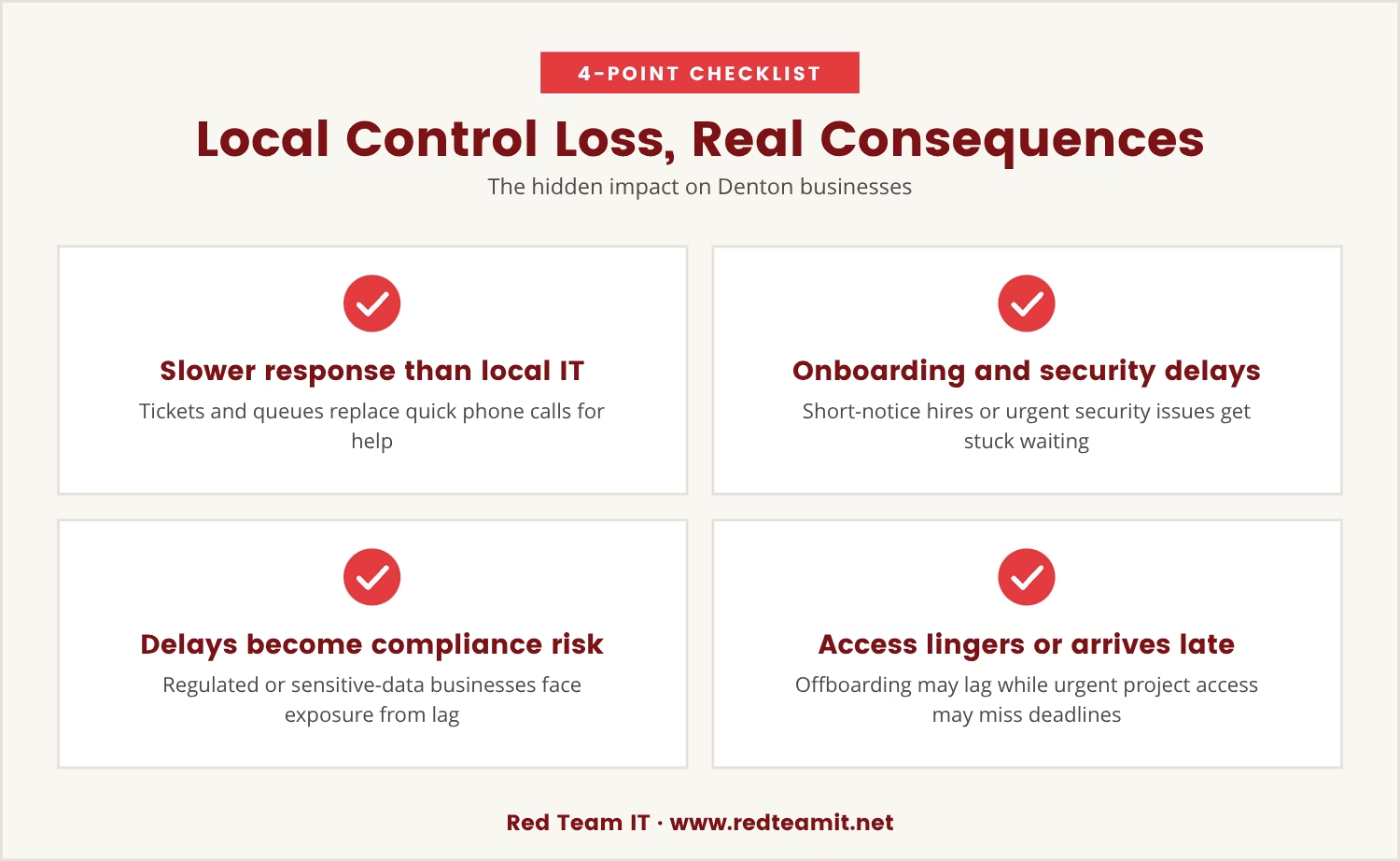
For a business in Denton, where local relationships and quick decisions tend to carry real weight, this loss of immediate control tends to stand out. A local IT contact might mean a phone call and an answer within minutes; an offshore or third-party provider usually means a ticket and a wait for that ticket to work through someone else's process.
That difference turns frustrating fast when a new employee needs to be onboarded on short notice or a security concern needs an immediate response. The provider might be sitting in a different time zone, or working through a queue stacked with requests from other clients—and even a provider that responds reasonably well still adds steps that accumulate.
For a business handling sensitive data or operating under regulatory requirements, those accumulated delays turn into compliance exposure. Access that should have been cut off the moment someone left might linger longer than it should, or access needed for a critical project might not arrive in time to matter.
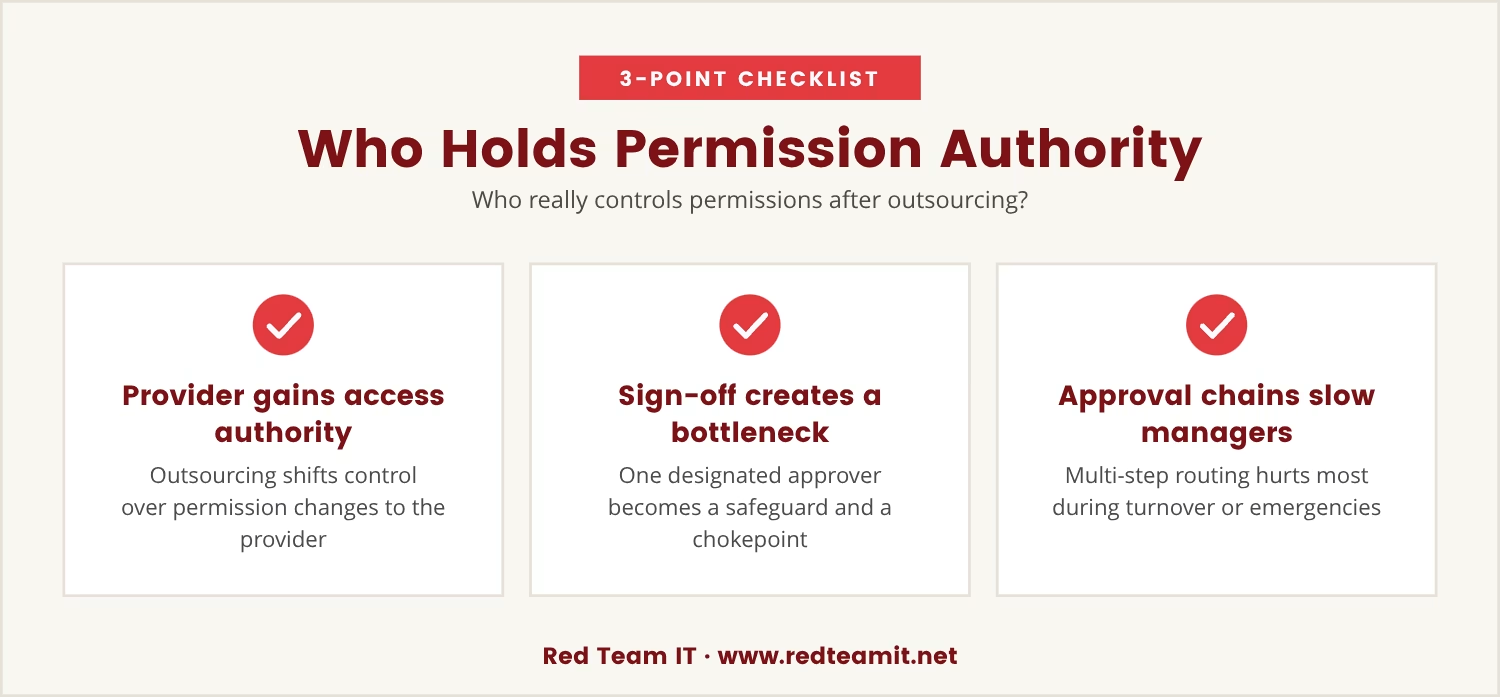
Outsourcing IT support typically moves the authority over access changes to the provider itself. That provider may require written sign-off from one designated person at the company before making any change—a safeguard, but also a bottleneck.
As a result, a manager who once updated permissions in minutes now has to route that same request through the provider's multi-step approval chain, which turns especially painful during staff turnover or a genuine emergency.
Consider how your business would handle a sudden need to change access for several users at once under your current provider's process. Would the team be able to act immediately, or would it be stuck waiting on someone else's response?
Outsourcing IT support delivers real advantages, but each one pairs with a risk worth weighing before committing. Here's the balance sheet:
Once IT support moves outside the company, delays in access changes tend to come from a handful of recurring sources, and knowing them in advance makes it easier to plan around them.
Strict approval procedures come first: every request has to be documented and reviewed, which protects data but adds friction. Time zone differences compound that friction further, adding hours or even days when the provider operates offshore. On top of both, providers juggle multiple clients at once, so a given request may simply not be first in line.
Combined, these three factors mean even a simple change can take longer than expected—a real risk for any business that depends on quick turnaround.
Weighing outsourced access control against keeping it in-house comes down to a short list of tradeoffs on each side.
Before outsourcing IT support, it pays to plan specifically for how access and permissions will be handled going forward. Start by mapping out exactly who inside the company needs to approve changes and how each request will get tracked.
From there, ask the prospective provider how urgent requests get handled and whether any guarantee exists around response times. Internal policies should line up with the provider's procedures so nothing comes as a surprise during a staff change or a security event.
Testing the process with a handful of sample requests before fully committing can surface delays or communication gaps early—and the clearer that process looks going in, the better protected the business stays.
Who controls access decisions isn't a minor technical detail—it determines how fast a business can respond exactly when speed matters most, whether that's a security incident or a sudden staff departure, where every minute carries weight.
For a company in a growth phase or one handling sensitive information, delayed permission changes carry consequences that reach past inconvenience: lost productivity, compliance exposure, even reputational damage. Seeing this hidden impact clearly is what decides to outsource IT support an informed one rather than a surprise later.

If your business has 5 to 150 employees—especially if you manage 50 or more users—you may be weighing the trade-offs of outsourcing IT support. At Red Team IT, we understand how important it is to keep access decisions quick and secure, even when support is managed externally.
We invite you to see how our approach to outsourced IT support keeps your team in the loop and your business protected. Let’s talk about how your current setup could be improved.
Switch your managed IT services to Red Team IT and get 20% off your first year if you qualify. This offer is for businesses changing their managed service provider.
Clear internal policies that define who approves access changes and how requests get submitted preserve a measure of control even after outsourcing. Dedicated contacts or dual-approval requirements for sensitive updates add another layer of protection. Regular permission reviews paired with open communication with the provider round out the oversight.
Ask about typical turnaround time for permission changes, the process for urgent requests, and exactly who inside the company is authorized to approve changes. Find out whether service level agreements (SLAs) guarantee specific response times. These answers head off surprises later.
Predefined workflows for common changes—onboarding or offboarding staff, for instance—can be requested directly from the provider. Backup approvers help avoid delays when key people are unavailable. A provider with local presence or 24/7 support can also shorten the wait.
Cost savings and access to a larger talent pool need to be weighed against the potential for slower response times. The business's actual need for speed and flexibility should guide the choice of provider, matched to a process that fits those needs. Regular reviews and clear agreements help keep that balance intact over time.
Slow onboarding, delayed responses to security incidents, and frequent staff complaints about access issues all point to a process that isn't keeping pace with the business. Tracking how long permission changes actually take makes it possible to catch these problems before they grow.